Crate training your puppy
Before you start actually using your
crate, your puppy will need to learn that it is a good place
to be. Many breeders begin the crate training before the
puppies leave, if this is the case with your puppy, still
follow the steps below, but expect to have a puppy who just
loves being in the crate very quickly.
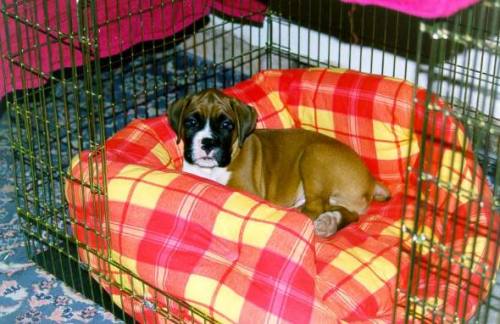
Charlie (8 weeks old) in his
crate
Take a tasty treat and / or toy. Lure the puppy into the crate, praise and make a general big fuss with the puppy while they are in the crate, give the treat, have a little game with the toy and then allow the puppy to come out of the crate. Do this 2 to 3 time in a row, several times a day. Your puppy will soon be running into the crate of his own accord, so you can now put a 'word' to the crate for your puppy. 'Crate' 'Den' or 'Bed' are quite good words to use.
Once your puppy is happy in their crate, close the door and leave them in there for a couple of minutes. If you do this when your puppy is tired in all they may even lay down for a sleep when you close the door. Keep repeating this, letting the time your puppy spends in the crate build up. If the puppy cries ignore him. Only open the door when the puppy is quiet and calm. If you do comfort the puppy or let him out of the crate if he is letting his displeasure show, he will be very quick to work out that this type of behaviour works to get what he wants.
You will soon be able to extend the time your puppy is in the crate. Many pups and adult dogs will retreat to their crate (or 'den' to their way of thinking) if they want some quiet time. The crate should be your pups own personal space, just for them, somewhere quiet but where they can still see what the rest of their pack (you and your family) are doing.
Never leave a young pup or adult dog in a crate for long periods of time unless absolutely necessary. The crate is just a training aid and safe house for your pup and should not become a total way of life. Young pups should be crated or denned for their own safety when they can not be supervised, but they need to come out frequently to go to the toilet - even at night. See the article on housetraining on how to manage calls of nature with your puppy.
As your puppy get older and more sensible (this is possible with a Boxer LOL), you will have to crate him less and less. You may find that you go several days without using your crate, but it is still a good idea to have your Boxer go into his crate occasionally so he is happy with it when you do need it. Many people leave the crates up all the time with the door permanently open and their dogs can go in and out of them as they please.
Crates are cruel. This statement is very true for the poor dog who is crated for 23 hours out of 24, but like anything, if used properly they are a wonderful tool. Dogs are natural denning animals - they like somewhere comfortable and safe. If introduced to the crate properly they love it. A dog accustomed to a crate will gladly run into it when the command is given, and be happy to spend some time in the crate. It is far crueller to leave a young puppy roam the house or yard unsupervised, as they could get into many things which could make them very ill or even cause their death. Far better to have them safe and snug in a crate when they can not be watched over.
Take a tasty treat and / or toy. Lure the puppy into the crate, praise and make a general big fuss with the puppy while they are in the crate, give the treat, have a little game with the toy and then allow the puppy to come out of the crate. Do this 2 to 3 time in a row, several times a day. Your puppy will soon be running into the crate of his own accord, so you can now put a 'word' to the crate for your puppy. 'Crate' 'Den' or 'Bed' are quite good words to use.
Once your puppy is happy in their crate, close the door and leave them in there for a couple of minutes. If you do this when your puppy is tired in all they may even lay down for a sleep when you close the door. Keep repeating this, letting the time your puppy spends in the crate build up. If the puppy cries ignore him. Only open the door when the puppy is quiet and calm. If you do comfort the puppy or let him out of the crate if he is letting his displeasure show, he will be very quick to work out that this type of behaviour works to get what he wants.
You will soon be able to extend the time your puppy is in the crate. Many pups and adult dogs will retreat to their crate (or 'den' to their way of thinking) if they want some quiet time. The crate should be your pups own personal space, just for them, somewhere quiet but where they can still see what the rest of their pack (you and your family) are doing.
Never leave a young pup or adult dog in a crate for long periods of time unless absolutely necessary. The crate is just a training aid and safe house for your pup and should not become a total way of life. Young pups should be crated or denned for their own safety when they can not be supervised, but they need to come out frequently to go to the toilet - even at night. See the article on housetraining on how to manage calls of nature with your puppy.
As your puppy get older and more sensible (this is possible with a Boxer LOL), you will have to crate him less and less. You may find that you go several days without using your crate, but it is still a good idea to have your Boxer go into his crate occasionally so he is happy with it when you do need it. Many people leave the crates up all the time with the door permanently open and their dogs can go in and out of them as they please.
Crates are cruel. This statement is very true for the poor dog who is crated for 23 hours out of 24, but like anything, if used properly they are a wonderful tool. Dogs are natural denning animals - they like somewhere comfortable and safe. If introduced to the crate properly they love it. A dog accustomed to a crate will gladly run into it when the command is given, and be happy to spend some time in the crate. It is far crueller to leave a young puppy roam the house or yard unsupervised, as they could get into many things which could make them very ill or even cause their death. Far better to have them safe and snug in a crate when they can not be watched over.